Virgil Thomson Award Announced

The American Academy of Arts and Letters has announced that I am the recipient of the Virgil Thomson Award in Vocal Music for 2020. The press release is here.

Needless to say, I count myself very lucky indeed, and am greatly touched that the distinguished jury (listed in the release) would consider my work worthy of this recognition.

I submitted two choral works to be considered by the jury: Carthage (a setting of a text by Marilynne Robinson - she’s an Academy member, maybe I’ll get to shake her hand at the Academy Ceremonial) and my Mass for the Day of St. Thomas Didymus, my setting of the Latin Mass interwoven with poems reflecting on the Mass texts by Denise Levertov. The latter will be performed by Emmanuel Music at Emmanuel Church in Boston on March 29 at their 10 am Sunday liturgy, and can be heard on a forthcoming CD of my choral music by The Crossing.

The award is for vocal music, so I will survey that part of my catalog in a subsequent post.

“Variations on a Hymn Tune” at Penn

University of Pennsylvania Symphony Orchestra

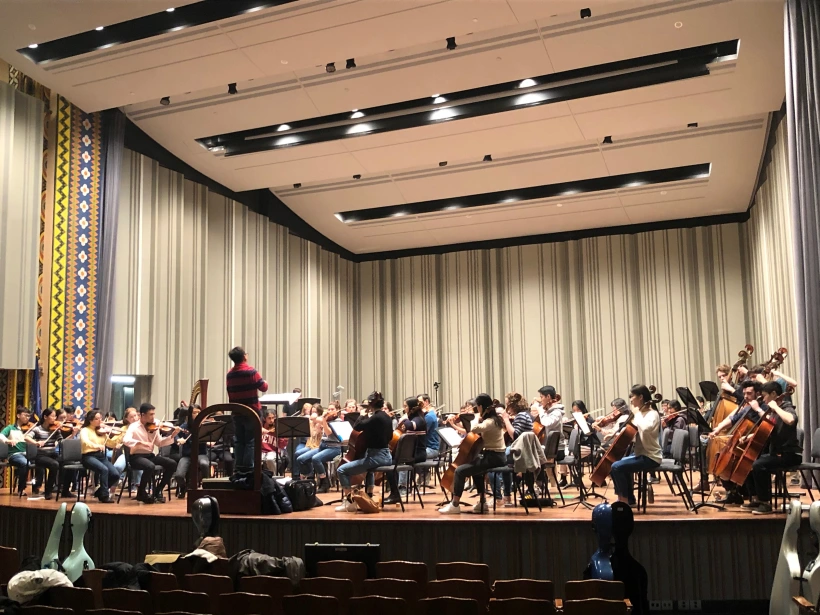
I took the above picture last night at a rehearsal of my Variations on a Hymn Tune with the University of Pennsylvania Symphony Orchestra, Thomas Hong conducting. They will be performing the piece this coming Saturday night, 2/22, at 8 pm in Irvine Auditorium on the Penn campus. There have been a few performances of the piece, both in the Philadelphia area and in the Midwest, but this is the first time it will be heard at Penn. Here’s a program note on the piece:

Composed at the request of the Council Rock School District in Bucks County, PA, these variations are based on a 19th century hymn tune called “Ebenezer”, written by Welsh composer Thomas J. Williams. I came to know the tune with the text “Through the Night of Doubt and Sorrow”, but my music does not reflect that somewhat lugubrious title! I tried to write a piece that would include a variety of moods, and would give each orchestral section a chance to shine.

After a short introduction, the hymn is heard in the violins. Variations 1 and 3 treat the tune contrapuntally, with the tune sometimes played at different speeds simultaneously. Variations 2 and 4 change the rhythm of the hymn more dramatically. The extended ending of the 4th variation recalls some of the gestures of the introduction.

The piece is in the Theodore Presser rental catalog, and Presser has posted an online perusal score of the piece here. While the work was written for a high school ensemble, it is certainly appropriate for college or community orchestras. The Penn Orchestra is doing a great job, and I am grateful to the players and conductor Thomas Hong for their work on the piece.


New York Festival of Song at the DiMenna Center

Thank you to pianist Michael Barrett and baritone Mario Diaz-Moresco for their eloquent performance of my From Psalm 116 as part of the New York Festival of Song “NYFOS Next” program at the DiMenna Center last week. There’s a thoughtful review of the program from Brin Solomon here on the National Sawdust Log. A review of an NYC performance is a rare thing, (not that it is common anywhere these days) and I am grateful to have a reflection in print about a concert in which I was involved.

From Psalm 116 is published by Theodore Presser and you can find it at their website here. The piece works well for mezzos as well as baritones - I had the privilege of performing it with Janice Felty a number of years ago.

I made a version of the song for baritone and chamber ensemble as part of the cycle Dark the Star, which includes settings of Rilke and Susan Stewart in addition to the psalm text. The song’s text is a psalm verse, sung in Latin, that may be translated as “Precious in the eyes of God is the death of his beloved.” Here’s a recording of the ensemble version of From Psalm 116, with William Sharp and the 21st Century Consort, conducted by Christopher Kendall. It comes from an album with four of my vocal cycles on the Bridge label.

P.S. - there was also a review by Sherri Rase  in Q on Stage.

Remembering Peter Serkin

I was sad to hear that one of the great master pianists has passed, one who understood as all too few performers of his stature do, that a deep commitment to the music of our time is perfectly consistent with the most profound relationship with the masterpieces of the past. I’m grateful for Peter Serkin’s Bach, but also for his Carter and Wuorinen and Wolpe and Lieberson and more.

The first time I heard the late Peter Serkin was in Cleveland’s Severance Hall in 1976. Charles Wuorinen had written a piece for Tashi, the mixed chamber ensemble that I believe Serkin and his colleagues had put together to play Messiaen’s Quartet for the End of Time. Wuorinen made a version of his piece (also called Tashi) for the ensemble and orchestra, and I heard the premiere, with the composer conducting the Cleveland Orchestra. Many years passed before I heard him again, but each time was memorable: Brahms 2nd with the Atlanta Symphony under Robert Shaw in Carnegie Hall; the Goldberg Variations at a Philadelphia Chamber Music Society concert; a program of short contemporary pieces, again for PCMS; and a Tanglewood performance of Messiaen’s From the Canyons to the Stars. I also heard him play some Peter Lieberson at a benefit event for Philadelphia’s Network for New Music. This was the occasion for a modest epiphany on my part. I had performed on the piano in the hall where the benefit took place, and I felt it was not such a great instrument. Hearing Serkin play it, I knew the piano was just fine. The problem had been the pianist.

Serkin playing a short piece by one of the contemporary composers he championed, Toru Takemitsu:

and a touching rendition of a Bach invention on a street in Maine:

Books about Rochberg and Hagen

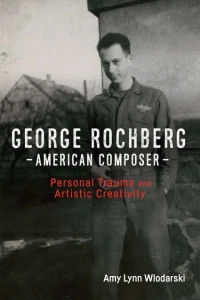
I recently re-read Amy Lynn Wlodarski’s George Rochberg, American Composer: Personal Trauma and Artistic Creativity, and I highly recommend it. Perhaps it was of special interest to me because Rochberg is part of my own history – I took two courses with him when I was a student at Penn, and have played his music on several occasions. (I am briefly quoted in the book, having spoken with Dr. Wlodarski as she was working on it.) But I think the volume is of interest to anyone involved with American music and recent music in general. The book is not the thoroughgoing life and works (like Howard Pollack’s book on Copland) that Rochberg deserves and I wish existed, though there is plenty of biographical information and insightful discussion of several of his pieces. Rather, it is a series of essays on various aspects of his life, with his traumatic experiences as a soldier in Europe during World War II as an overarching theme. Dr. Wlodarski has dug deeply into the Rochberg archives at the Sacher Foundation and discovered the facts about Rochberg’s wartime experience that he rarely, if ever, talked about. Rochberg served approximately 250 days in active combat duty, was wounded twice, and was even jailed briefly for insubordination when he refused an order to lead his men into what he felt would have been certain death. The book’s chapters deal with Rochberg’s wartime experience, his creative path to what he called Ars Combinatoria (his use of wide-ranging styles and materials in his work, encompassing both pre-20th century and modernist idioms), his identity as a secular Jew, and his work as a teacher. Much of the book is taken up with Rochberg’s own prose writings, and Dr. Wlodarski is helpful in elucidating and providing perspective on that aspect of his work. I mean no criticism of the book when I point this out, but I have to say I value a piece like the Symphony Nr. 2 or Serenata d’Estate more than all his essays put together. Bravo to Amy Wlodarski for an elegantly written book that provides vital information about an important American artist.

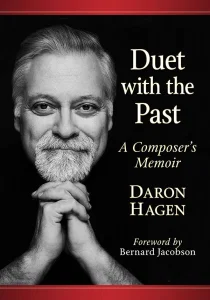
Daron Hagen’s memoir, Duet with the Past, was fascinating to me, partly because – like the Rochberg book – his history and my history overlap a bit; for example, we were both in New York in the 1980’s. (I think it was maybe at Daron’s apartment that Christine Schadeberg and I tried out a performance of Book of the Hanging Gardens that we were preparing). But apart from this egocentric reason for enjoying the book, I was intrigued by it because of Daron’s experience with what feels like an earlier part of American musical history. Daron studied at Curtis and Juilliard. His mentors and musical touchstones include Rorem, Diamond, and Bernstein. Though Rorem is still alive and was not particularly connected with Copland, I don’t know another composer roughly of my generation (Daron is a bit younger than myself) of comparable prominence who has those connections with important figures who in turn connect with Copland; this contrasts with my own connections with teachers of a later era like Crumb and Davidovsky (though now that I think of it, Mario himself had a thread of connection with Copland, as it was through Copland that he came to Tanglewood and thence to the Columbia-Princeton Electronic Music Center.) Also, Daron worked as a music copyist in New York, which again feels like an experience from an earlier era, after decades of composers relying on computer engraving software.

The book reveals that Daron has survived more than his share of trauma as well, though it sprang from his family experience, not wartime service. There is material here about productions of his operas and performances of his concert works, his affectionate relationship with the artist colony Yaddo, and his redeeming second marriage and fatherhood. The book is a brave, revealing, and touching enterprise.

Four Performances This Weekend

Sometimes there is a dry spell when there are no performances of my music for an unpleasantly long time, and then there are moments when a cluster of performances congregate within a short period. This coming weekend is one of the latter. Two pieces: one from a few years ago, receiving three performances; and one being performed for the first time. Here are some details.

Kaleidoscope Chamber Orchestra, an organization based in L. A., has included my Oboe Quartet on three concerts set for this weekend in Santa Monica, Pasadena, and Santa Barbara. Find all the details here. I wrote the Quartet at the request of oboist Peggy Pearson who gave the first performances with members of the Apple Hill Quartet back in 2015. I met Peggy through my work with Emmanuel Music, the group with which she has played Bach cantatas for decades as part of the liturgy at Boston’s Emmanuel Church. Winsor Music programmed the piece that season, and there is an interview with me in connection with that performance here. Read more about the piece in this blog post. Theodore Presser Company has posted a perusal score of the piece here, and you can listen to the piece here - scroll down past the videos or use the link at the top of the page to go to the sound clips.

The other piece being done this weekend is a premiere, a short work for SATB chorus called Wind, Carry Me. Here’s my program note on the piece:

When invited to compose a new work for the PMEA District 11 Chorus, I immediately turned to my friend Susan Stewart, a distinguished poet whose words I have set in several pieces. I asked Susan to write a new poem for the project. She responded with a text that speaks of challenges and yearning, but also of capability. While my setting uses conventional chords, these are often juxtaposed in an unconventional manner. Throughout the piece, sections of the choir call to one another, finally coming together in unison at the climax, and ending with determination and strength. 

The work will be sung by about 160 high school students selected from a number of schools in the region in a concert at Springfield High School, Montgomery County, not far outside Philadelphia, conducted by Cristian Grases. This is by far the biggest group of people to perform my music! The Mendelssohn Club of Philadelphia has done my music a number of times, and is a big choir with roughly 80 to 100 singers, but the size of this high school group is something extraordinary.

Here are a few lines from Susan’s beautiful text, ending with what I hear as the climax of the poem:

I said to the moon
turn to me, turn to me

I said to the star
send for me, send for me 

I said to the night
harbor me

Then I said to my love
I’ll come to you, wait for me

The commission for this piece came about through the advocacy of Andrew Puntel, who teaches at Springfield High School. I came to know Andrew through my work as a church musician at St. Genevieve’s in Flourtown, PA, where he directed the music ministry until recently. I’m grateful to Andrew for proposing the piece and finding the funding for the commission.

This is not the first piece I have written specifically for young musicians. My Variations on a Hymn Tune was written for Council Rock South High School (outside Philadelphia) a number of years ago. Completely by coincidence, that piece will be done twice this season, both by the University of Pennsylvania Orchestra and by an all-state ensemble in Delaware - there is more information at the performances page.
Catching Up on CDs, Recent and Not

This is not a “best of 2019” list, and some of these CDs have been waiting patiently for a mention on this blog for quite a while. But they are all items that I think are worthy of your attention.

  • Richter in Wien Prokofiev: Sonata Nr. 2; Stravinsky: Piano-Rag Music; Shostakovich: Preludes and Fugues in E-flat major and C minor; Webern: Variations; Bartok: 3 Burlesques; Szymanowski: two pieces from Metopes; Hindemith: Suite ‘1922’. London. This appears to be a bootleg from a 1989 recital. The piano is terrible, there is a fair bit of audience noise, but it is fascinating to hear this artist in an all 20th century program of little-heard works. Richter playing the Webern Op. 27? Yes, and very well indeed.
  • Hummel: Piano Sonatas Stephen Hough. Hyperion. This album makes a fine case for this late-18th, early 19th century composer, and is gorgeously played and recorded. The music is a little like Beethoven in its mix of classical and romantic features.
  • Harbison: Requiem Nashville Symphony Chorus and Orchestra, Giancarlo Guerrero. Naxos. His music steeped in Bach, Harbison is a master of choral writing. This is a mostly sober setting of the Latin texts, without interpolations, but no less moving for avoiding the theatrical.
  • Convergences. Works by Brahms and Andrea Clearfield. Barbara Westphal, viola; Christian Ruvolo, piano. Bridge. Featuring arrangements of the Brahms E minor cello sonata and the G major violin sonata, this album offers some welcome additions to the viola repertoire. I felt the violin adaptation was more successful, maybe because the original version of the cello piece is in my bones from playing it many years ago in college. The Brahms works are smartly complemented with a well-crafted 2008 work by Philadelphia-based Andrea Clearfield.
  • Lounge Lizards works by Fred Lerdahl, John Musto, Charles Ives, Arlene Sierra, and Michael Daugherty. Quatro Mani (Steve Beck, Susan Grace, pianos). Bridge. These folks are masters of the unforgiving two-piano medium, where the least bit of imprecision is painfully obvious. My favorite pieces were the Ives, of course, and the elegant Lerdahl work, simply called Quiet Music – quiet, perhaps, but packed with thought, wit, and imagination.
  • The Way Things Go works by Randall Woolf, Steven Mackey, John Halle, Eric Moe, Belinda Reynolds, Richard Festinger, and Laura Kaminsky. Tara Helen O’Connor, flute; Margaret Kampmeier, piano. Bridge. Brilliant playing in a program including nicely diverse idioms. Favorites for me were an early Steve Mackey piece called Crystal Shadows, and Eric Moe’s All Sensation is Already Memory - the title is from Henri Bergson - and the piece is as elegant as its title.
  • R. Murray Schafer: The Love that Moves the Universe Vancouver Chamber Choir,  Jon Washburn, conductor. Grouse. I think of Schafer as more of an experimentalist, but these pieces are direct in expression and varied in character, ranging from a children’s fairy tale to a setting of Dante. Fine performances.
  • American Trombone Concertos Works by Paul Creston, George Walker, Gunther Schuller, and Ellen Taaffe Zwilich. Christian Lindberg, trombone; Malmö Symphony Orchestra; James DePriest. Bis. This album, dating from the 1990s, presents works by important composers who should be better represented on record. In a healthier musical climate, these pieces would have been recorded by a first-rate American orchestra, one as fine as Lindberg is a soloist.
  • The Purity of the Turf  Ethan Iverson, piano; Ron Carter, bass; Nasheet Waits, drums. Criss Cross Jazz. The Iversonian imagination in all its freshness is evident throughout this 2016 mix of standards and originals. Especially striking is a treatment of Darn That Dream; by truncating the form, Iverson creates a sense of claustrophobia that makes this dream a compelling nightmare.
  • Shi-Hui Chen: Returning Souls. Various performers. New World. Elements from Asian and Euro-American musics are successfully melded, not just juxtaposed in these chamber pieces. Fantasia on the Theme of Plum Blossom, played by the Formosa String Quartet, is especially impressive. More than just a presentation of varied materials, it’s what Chen does with that material that makes this music matter.

“Wozzeck” at the Met

Have you seen the current production of Wozzeck at the Met? It’s been generally favorably reviewed, but I was troubled, as was, to some extent, Alex Ross in The New Yorker. The Kentridge production is simply too visually busy. The projections – some animated, some slowly shifting, amidst a cluttered set full of ramps and junk – were a distraction from Berg’s intricately crafted score. Maybe this kind of thing worked for The Nose, the Shostakovich opera presented by the Met in a Kentridge production several years ago; with thinner music, perhaps there was room for such a flood of images. Specific moments troubled me as well. It added nothing to have Wozzeck fussing with a film projector in the opening scene instead of shaving the Captain, apart from the obvious point that the production was packed with projections. I agree with Ross that the projected explosion at the climax of the last interlude was cringe-inducingly obvious. Ross welcomed Kentridge’s choice to start the scene in the tavern after the murder of Marie during the second of the two crescendi on B-natural, but I disagree. Not only did this spoil Berg’s cinematic jump cut to the tavern scene and its out-of-tune upright piano, but it distracted from what would otherwise have been the overwhelming power of the crescendo, which should fill your consciousness at that moment, just as it fills every musical register. Kentridge’s preference for slowly shifting images throughout the evening went against Berg’s choice of an abrupt juxtaposition at that moment. All night there were haunting images, but too many of them. (Was one of the projected images of detached heads in a field supposed to look like Schoenberg? That would be a fine piece of Freudian patricide on Berg’s behalf.) The performance was very fine; do I remember Levine’s performances as more shattering because of their inherent properties, or because I was struggling to attend to the music last night?

“Journey” premieres at Emmanuel Church

It’s hard for me to believe that the first piece I wrote for Emmanuel Music to perform at the Sunday Eucharist at Emmanuel Church, Boston dates from 1994! I am so grateful for my ongoing relationship with this church, which has included my music in their liturgies many times in the years since that first piece. (Check out my work list page for a complete list of my choral music, including the pieces written for Emmanuel.) There will be a new work done at Emmanuel this coming December 21 at 7:30 pm, a Meister Eckhart setting called Journey. The piece sets a text by Jon M. Sweeney and Mark S. Burrows which is a poetic rendering of a text by the German mystic. You can read more about my setting here. The premiere will be at a special service, Blue Christmas on the Longest Night. A recent e-mail from Emmanuel described the service this way:

Recognizing that the Christmas holidays are not a time of cheer for everyone, Emmanuel Church with the clergy and congregation of Church of the Covenant, reaches out to the those who are grieving the death of a loved one or dealing with other kinds of loss. The reflective service offers prayers for healing and quiet meditation. Emmanuel Music will present James Primosch’s Journey on this evening.

Emmanuel is making a tremendous commitment to my music this year in that not only will they premiere this new piece, but they will perform my big Mass for the Day of St. Thomas Didymus, programming individual movements on several Sundays, and then performing the entire piece in lieu of their customary Bach cantata on March 29, 2020. Go to the performances page for details. Here is The Crossing, the group that commissioned my Mass, giving the first performance of the piece: